
Contents: Thing You Need To Know; Basics; Integrated WiFi Networks; Automated Controls; Data bus Systems; Event Data Recorders; Data Corruption; Code Readers; Electronic Engine Controllers; Battery Monitoring Systems; RFI Egress; RFI Ingress; Think Ahead;
Several after-market companies offer devices which plug into the OBDII port. They record operating data from the port, and either memorize it for later download, or upload the data to a smart phone and/or the Internet. In some cases, data can be downloaded to the OBDII system. While appearing innocuous, these devices can interfere with the operation of the engine, stability, ABS, traction, and other control systems to say nothing about their RFI potential. Several automobile manufacturers have issued technical bulletins regarding their (essentially illegal) use. In some cases, warranty coverage could be denied, especially so if the pollution control systems are compromised. If you're contemplating using one of these devices, do yourself a favor, and check with your dealer personnel afore hand.
Starting with the 2016 model year, several automobile manufacturers are uploading vehicle data via built-in networking systems. For example, GM's prognostics system (so called for obvious reasons) transmits several engine parameters via their OnStar system. Ford transmits similar data through their Sinc-3 system, and any connected smartphone. Technically, even cockpit audio (now being recorded in several GM models) could be relayed back to GM. What they do, or plan to do, with such data remains to be seen, but certainly preventive maintenance alerts are part of the plan.
The most insidious part of this data collection, is that it increases the likelihood of the systems to be hacked. After all, it is possible to unlock doors, track stolen vehicles, and disable them when necessary. It is also important to remember, modern vehicles often have their electric-power-steering, braking and stability controls, and transmissions under engine computer control. Fore warned, is fore armed!
And just for the record, most jurisdictions require a search warrant to obtain data from on-board data collection systems. However, automobile entities often use the data not only to support warranty claims, but as a routine procedure to diagnose problems, sometimes before they happen! The implications are obvious.
Due to today's litigation climate, it is not uncommon for automobile dealership personnel to tell potential buyers that installing two-way radio equipment into their vehicles will void their warranty. Nothing could be further from the truth! The common thread seems to be the damage which can (will) be caused to these computers when subjected to high level of RF generated by amateur radio. This is a blatant misrepresentation of the real facts! 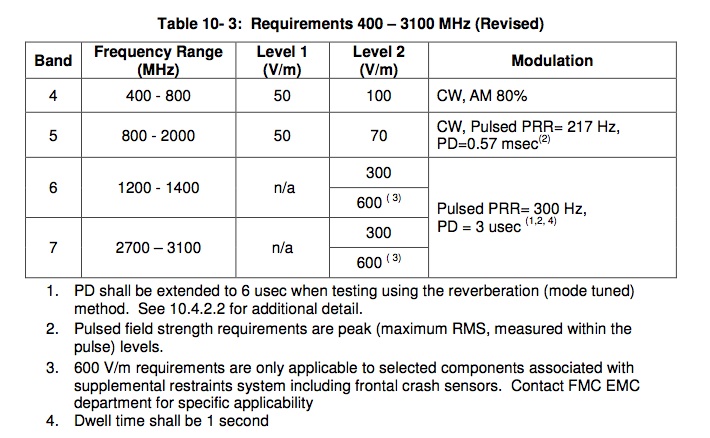
Manufacturers go to great length to test all of their electronics, whether they make them, or purchase them. The included charts are from Ford Motor Company (click for enlarged views). The Level 1 Requirements chart (right) is dated 2003, but has been updated several times. The latest version extends this to 3,100 MHz to cover the new cellular bands. The complete documentation can be read here Electromagnetic Compatibility. They represent the minimum testing level. In other words, the various on-board devices must pass muster when subjected to the RF level so listed.
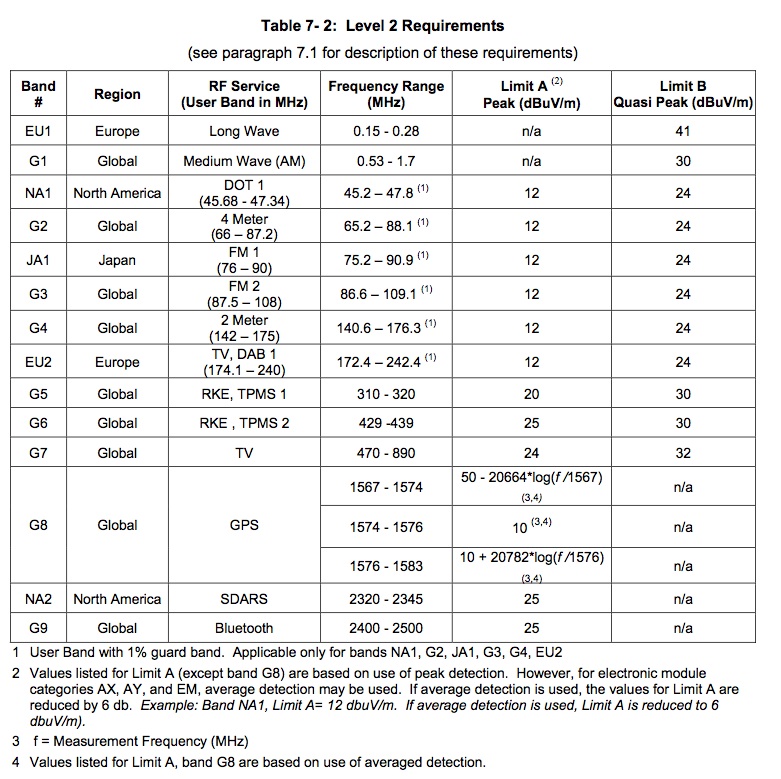 This chart (left) is the Level 2 Requirements, and includes variations based on the country in question. The real truth behind the data, you'd almost have to connect your coax directly to the devices in order to damage them! The chances of damaging them from radiated energy from amateur equipment is virtually nil. You can, however, interfere with their operation by causing false signals to be presented to them.
Probably the worse offenders are improper wiring. Most vehicle manufacturers publish installation guides to avoid this issue. Here are the from Ford and GM. The ARRL web site has them listed for most other makes located here. Poor antenna mounting schemes, common mode issues, and inadequate motor lead choking round out the top four causes of RFI. Although the finer points are explained in the wiring article, it is important to reiterate them here.
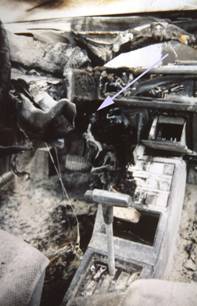
1). Power connections should be made directly to the battery and/or jump points, and fused as close to the connection as possible. Do not use cigar lighter or “Power Point” receptacles as power sources for any radio communication equipment. The comment about power point receptacles is very poignant. If you are using one of these, you're running a very great risk of an electrical fire, which is without doubt, the costliest of vehicle repairs. Click of the photo below right for a reality check. The arrow is pointing to what is left of a power point plug, and its attached wiring.
 2). Antennas for two-way radios should be mounted on the roof or the rear area of the vehicle. Care should be used in mounting antennas with magnet bases, since magnets may affect the accuracy or operation of the compass on vehicles, if so equipped. The comment about mag mounts is also poignant. They can, and do, cause erratic operation of Navi equipment as well.
3). The antenna cable should be high quality, fully shielded coaxial cable, and kept as short as practical. Avoid routing the antenna cable in parallel with vehicle wiring over long distances. This is especially important due to common mode concerns. The comment about keeping coax runs short and away from internal wiring is for those who don't properly install their antennas, and end up with excessive common mode currents. Control common mode, and it doesn't make any difference where the wiring is routed.
4). Carefully match the antenna and cable to the radio to achieve a low Standing Wave Ratio (SWR). And, carefully mount antennas to avoid RF currents on the antenna cable shield (I.E.: common mode current). Improperly mounted, and matched antennas is the major cause of excessive common mode.
There is one more common problem which should be noted, and that is ground loops. Mag mount antennas, and using the chassis for DC ground returns is a sure-fire way to create a ground loop. Ground loops are the hardest of maladies to find, and cure because they mask themselves as RFI ingress. It is simple to avoid them with proper wiring and mounting.
Just because you have never experienced a problem using a mag mount antenna, doesn't mean you're not having any. It just means you haven't discovered them! For example, it is possible to cause error codes to be written to the OBDII-EOBD memory. Whether or not these codes illuminate the MIL (Maintenance Indicator Light) is moot!
Vehicle manufacturers now offer integrated WiFi networks on most models. They're no different than those we all enjoy at home, replete with browser and everything a browser represents. Internet support is via On-Star®, Sync®, or a similar system. But with a home network you normally control the uploading of information. In the vehicle's case, the manufacturer has the ability to upload just about every facet of the vehicle's operation, and they don't have to ask permission!
Eventually, vehicles will be talking to other nearby vehicles, is a coordinated effort to avoid crashes, and other safety-related issues. In fact, the NHTSA has ask for input from the various vehicle manufacturers on this very issue. And, when vehicle WiFi networks are integrated with on-board Navi systems, it is possible to use the information to pinpoint your location, and offer alternative routing. Or, to even send advertisements for businesses you're driving close to! This may sound insidious, but currently (2021) there are no fed laws or regulations covering what can be uploaded, or downloaded. So anyone with a bit of computer savvy, will know exactly where you are, what you're doing, and in some cases, what you're saying as well!
All passenger vehicles sold in the US are required to have collision-avoidance systems. These systems use radar and/or infrared sensors to detect an impending collision, in front or along side (lane-change collision avoidance). Acting in conjunction with the ABS, the VSS, the cruise-control system (if being used), and the electrically-assisted steering, these systems can literally out-think the driver! All of these systems are interconnected via the various data bus systems as discussed below. The current epitome of these technologies, is Tesla's Auto-Pilot.
And remember, the biggest offenders of RFI ingress of these systems is common mode radiation from the coax, and improper power wiring. These issues are discussed below as well.
Digital electronics have become very pervasive in modern vehicles. Current models have as many as 80 digital processors controlling every facet of operation, and more are coming with every new model year! Most of these processors talk to one another over data bus systems. The OBD II, along with the various on-board processors, use ISO-defined networking to transfer data between them. This eliminates redundant signal paths, and allows sharing of the various sensors. They're commonly called B-CAN (Body Chassis Area Network), but may be known by other acronyms. For example, Honda calls theirs MICS (Multiplex Integrated Control System). In this case, three separate bus systems operate using bit rates of 10.4 kbps, 33.33 kbps, and 500 kbps. Other makes are similar in nature, and all produce birdies up and down the amateur spectrum. It should be noted that RFI egress (interference from the on-board electronics) is much more severe than RFI ingress (to those same electronic devices). The really bad news is, manufacturers will not address any concern whatsoever, with respect to these spurious signals. Remember, they are exempt under FCC Part 15 rules.
Some vehicle computer systems use a color burst crystal as an oscillator (3.579545 MHz). The 41st harmonic is 146.76134 MHz, which causes problems with the 146.16/76 repeater pair. However, component tolerances can cause the harmonic to be anyplace between about 146.70 MHz, to as high as 146.80 MHz.
The worst birdie offenders of all, are hybrid drive systems. The birdies from their digital control circuitry, virtually wipe out the HF and low VHF spectrum. If you own one, or are thinking about buying one, and intend to operate HF mobile, you're in for a rude awakening.
There is one very important item to remember about suppressing the data bus system's digital signatures—you can't! In fact, attempting to do so can disrupt the digital signals, the harmonics of which you're attempting to filter out. About the only course of action is to properly mount your antenna(s), and install a common mode chokes on the coax feed and motor lead lines to minimize RF leakage in or out!
Most modern vehicles have a myriad of transient voltage protection built-in to the various electronic sub assemblies to protect the on-board digital electronics. Even the alternator diodes act like load-dump transient suppressors. Sometimes, these devices can be compromised by external battery chargers, and 24 volt jump starting battery packs. Forewarned, is always forearmed!
Known as EDRs (and facetiously as black boxes), these devices record specific data which can be retrieved later. A good example is the OBD II (On-Board Diagnostic, level two), which has been mandated on every vehicle sold in the United States since 1996. The latest iterations record all manner of data collected by the various on board devices. The latest versions are referred to as OBDII-EOBD, with the latter standing for Extended On-Board Diagnostics, and are required on all vehicle starting with the 2012 model year. There is even a new standard for non passenger vehicles, called HDOBD. If you would like to read an overview of the history of OBD, here is a Wikipedia page covering the devices.
Heretofore, the OBD II recorded mostly engine functions, such as misfires, inoperative devices, or sensor failures. The various codes are stored, which may or may not turn on the MIL (Maintenance Indicator Light), and can be retrieved using a code reader. The collected data on later versions includes, but isn't limited to, engine RPM, speed, cornering Gs, braking force, steering angle, throttle position, and temperature. All of the data are important when analyzing a crash scenario; the real reason for the data collection in the first place. In addition, manufacturers have their own set of parameters. For example, GM EDRs record instances of over revving which could cause severe engine damage, especially in high-performance vehicles like the Corvette, and Cadillac V series.
Although not strictly a data recorder, several late-model vehicles are equipped with a voice recorder module. The module records the last few (≈30) minutes of cockpit audio. Access to the recording is restricted by a password supposedly known only by the manufacturer. However, a few Google searches will net you the password algorithm (based on the VIN). You can't erase the recording, and neither can anyone else. Legally, it takes a court order to access the recording by the police, but that's of little solace if you're the cause of a vehicle crash.
While the various control CPUs may be all but bullet-proof RFI wise, all of the various on-board sensors are subject to excessive levels of common mode current, and ground loops. When they are affected, the MIL (Maintenance Indicator Light) may be illuminated. Dealerships charge an average of $50 to reset the MIL, and readout the codes. Code Readers are an inexpensive alternative than going to your dealer.
Every mobile operator has, or has had, instances of both RFI ingress and egress. For example, ignition noise is a pervasive egressed RFI we all have to deal with. However, some forms of ingress may not be pervasive enough to be noticed. For example, modern speedometers use solid state electronics to store the mileage in a form which cannot be "rolled-back" by unscrupulous mechanics. However, the trip data is typically stored by volatile memory. If you disconnect the battery, the data goes away.
Data corruption caused be RFI ingress and/or egress, will often have different effects (or lack there of) at different frequencies. For example, you might not have any RFI problems on 20 meters, but that doesn't mean you won't have them on some other band.
Worse, Federal courts have ruled that the software and/or firmware controlling every facet of vehicle operation, is owned by the manufacturers! This has independent repair shops up in arms for obvious reasons. And, it opens up Pandora's box with respect to data corruption which might be caused by excessive RFI ingress (Common Mode?). However, automobile manufacturers do a very creditable job of bullet proofing their electronics against RFI ingress. Ford Motor Company is a prime example. They thoroughly test their electronics, and they even support a web site for what they call Electromagnetic Compatibility (EMC). Although aimed at OEM suppliers, the data presented can certainly be of interest to any amateur radio operator with an RFI ingress problem.
It should be noted, that not all RFI-related data corruption will cause error codes to be written to the OBDII-EOBD. And, as mentioned above, RFI can play havoc with the individual data sensors connected to the various on-board electronic devices.
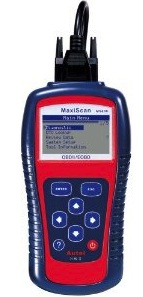 One way to know if you have corrupted data, other than the MIL, is to buy a code reader. Auto Zone, O'Reilly, Pet Boys, and others sell OBD II, and EOBD readers. Pricing, depending on the units reading capabilities, range from $29 to well over $200. They come with a book or CD-ROM listing all of the various error codes. Most can also turn off the light, and clear the memory. Considering the cost to have your dealer turn off the light, an OBD II-EOBD reader could be a bargain in the long run.
If you buy one, make sure it is capable of reading the EOBD (extended on-board diagnostic) codes, like the Autel AL510 shown at right. Remember, all US vehicles made after the 2012 model year, must have EOBD. This includes light and medium duty trucks, and SUVs.
By the way, as mandated by fed law, the code reader socket is located beneath the steering column. If it is not located at that spot, there must be a sticker telling you where it is located. This fact just proves how anal retentive fed thinking is!
Some automobile manufacturers password encode access to the extended data. Fortunately for most makes, a Google search will net you the password. Problem is, in too many cases you need a second password to reset the extended data. In some high-end units, the extended data cannot be erased, unless a code is sent to the unit via its navi or cellphone interface. Speaking of which, some of the collected data is sent back to the manufacturer on the same interface, without the driver's knowledge! Hopefully, that doesn't include the last 30 minutes of cockpit audio several manufacturers now collect. These issues will become even more important as vehicles start talking to one another over WiFi in the near future.
In an effort to implement reasonable measures to protect personal information from unauthorized access, Aston Martin, BMW, Chrysler, Ferrari, Ford, General Motors, Honda, Hyundai, Kia, Maserati, Mazda, Mercedes-Benz, Mitsubishi, Nissan, Porsche, Subaru, Toyota, Volkswagen, and Volvo, all signed a joint agreement with the Federal Trade Commission in November 2014. This agreement outlines what types of data can be collected, and who will and will not have access to the data without a court order. Let us all hope it works for us, not against us.
If you own a late-model vehicle, you need to be aware of the following. They all use their EEC (Electronic Engine Control) to monitor the alternator's voltage and current. These readings (in part) help control the fuel injector timing, hence the mixture, which also improves gas mileage. As a result, at slow engine speeds, when the alternator is under a varying heavy load (amplifier use for example), the engine may hunt (stumble and misfire). In some cases, this will cause an error code to be sent to the OBD II which turns on the MIL (Maintenance Indicator Light).
In some cases, the data error codes can tell you where to install RFI suppression beads. One of the codes I was seeing related to the throttle position sensor. I installed a bead on its wiring harness, and that particular code hasn't reappeared. By the way, just because the MIL isn't on, there may very well be stored error codes! Some of these may not be amateur radio related, and could indicate an actual problem.
The OEM alternators on most of the newer model vehicles utilize a double wound field coil replete with 12 diodes. For example, the Honda Ridgeline comes equipped with an 130 amp alternator that is physically smaller than Honda's old-style 6 diode 105 amp unit. All Honda vehicles now come with this type of alternator (except the hybrids of course), as do most other makes, and models. Fact is, a couple of large SUVs come with 250 amp, 12 diode alternators, but you can't tell from their size. All of this upgrading in amperage is a good thing for us mobile operators. More information is in the Alternator article.
Since 1996, all vehicles come factory equipped with fuel vapor purge canisters designed to reduce hydrocarbon emissions. Almost universally, these systems continue to run (including the data bus systems supporting them) until the engine oil pressure drops to zero. Some systems, notably Toyota's, do their diagnostic testing long after the engine has been shut off, rather than at engine startup. Testing may occur up to five hours later, once the engine coolant drops below 95°F. So, if you're out in your garage, and you hear something running, it's probably the vacuum purge pump. Since the data bus is also operating, it is possible to hear the RFI hash from both. Obviously, this is not something to worry about once you know what is happening.
Due partly to meeting new fed-mandated fuel economy standards, more, and more new vehicles are designed to shut off the engine when it isn't needed—at a stop light for example. Realizing that life doesn't stand still as well, special devices are being installed which monitor the condition of the battery. If the battery isn't up to snuff, or the accessory load is such that the battery might not be able to restart the engine, the engine remains running or restarts as the case may be.
Both the voltage, and the current draw from the battery are measured. The latter measurement incorporates a Hall device located very near the battery. In the case of Ford, and Nissan (et. al.), the Hall device is part of the negative battery connector. In addition to the BMS, most systems also incorporate a battery booster of sorts, to maintain the voltage level fed to the accessories like the Navi system, entertainment devices, and even the instrument cluster.
Battery Monitoring Systems have been with us for some time. BMW for example started using them way back in 2002. As they become more popular, we'll get a better view of their ability to handle the installation of amateur radio gear. Until that time, is behooves readers to peruse the Caveat section of the Wiring article.
Modern EECs are what allows late-model, high-powered vehicles to achieve almost unheard of mileage ratings. One of the strategies used is ELD (Electrical Load Detection). Any load applied to the electrical system will be measured, and the requisite changes in engine settings to match that load will be adjusted. Although they work well for most automotive needs, imposing SSB, and its ever-changing power needs, often overtax EEC systems. This may cause engine stumbling, or erratic shifting patterns as the ECC tries to compensate for the rapidly changing load. Whether this causes the MIL to illuminate is perhaps moot, but it can be scary to the neophyte. RFI ingress can also cause this problem, if the level is high enough to interfere with any of the various sensors feeding the EEC, or the EEC itself.
The one thing we'd all like to see, is an equal effort directed toward reducing RFI egress. Of particular importance are those associated with the control electronics in hybrid vehicles, as owners of Toyota's Prius can attest to. Some are so RFI noisy, their AM radios are nearly useless in low signal areas. Adding some insult, are COP ignition systems. While later model units have lower RFI levels than earlier models exhibited, they're far from ideal. As a whole, automobile electronics are a major contributor to the overall background hash we all have to endure.
Fuel injection systems are yet another bothersome source of RFI egress. The latest iterations spray the fuel directly into the chamber (rather than in the intake manifold airstream), and use very high pressure to do so. This requires the injector solenoids to be somewhat more powerful than earlier systems, so the resulting EMI (electromagnetic impulse) is much greater.
One unfortunate fact; automobile manufacturers are exempt from the FCC's Part 15 (Section 15.103, Exempted devices). While there are suggestions that the exempted devices should meet certain radiation levels, the fact remains they are exempt. Until the rules change (not in the foreseeable future), we're all going to continue to suffer ever-increasing levels of RFI egress.
One good aspect of mobile busing systems is the simple fact they're getting more complex in design, with much higher data handling capabilities. As a result, the digital noise they generate has to be better controlled. Read into this, less signal leakage in and out of the digital wiring. We all should welcome any reduction in the digital hash, and birdies generated by most of the current data bus systems.
LED lighting is yet another source of RFI egress. For the most part, OEM systems are fairly RFI free, but almost all after-market ones generate an excessive amount of RFI. This is especially true of those units which use a black box to drive multiple headlight LEDs. Best stick with halogens in these cases.
RFI ingress can be annoying, but thankfully it is usually easy to cure. Sometimes a single bead will suffice, perhaps a bonding strap, and sometimes low-current wiring (i.e.: antenna motor control leads) will have to be shielded. One very important thing to keep in mind; for any given RFI problem, what worked on your last install, might not work on this one.
As alluded to above, RFI ingress can cause sensors to send the wrong data back to their respective control devices. These may include, but aren't limited to, automatic braking systems, automatic transmission controls, electric power steering controls, and vehicle stability systems. If for any reason you experience issues with any of these, you should stop transmitting immediately! The next step is to cure the RFI ingress. This may require changing the antenna mounting methodology and/or location, installing more adequate wiring, doing additional bonding, additional choking impedance to the antenna's motor control leads, and better common mode current suppression to the coax cabling.
The vehicle style and type is usually dictated by the size of the family, the number of vehicles owned, and to some extend the use for the vehicle. It is a rare purchase indeed, when the installation of amateur radio gear is included in the buying plans. When it is, the first order of business should be the proposed location of the antenna, the location and methodology of the radio mounting, and the necessary accessory load (large alternators etc.) to support it, keeping safe operation in the forefront all the while.
Sharp-eyed readers will notice the word purchase in the last paragraph. While some folks do lease vehicles, it is one of the most expensive ways to drive a new vehicle every few years, especially so if you have no way to write off the extra expense. For some reason, the fact the vehicle is leased is a typical excuse for not properly installing radios and antennas. The usual comment is, my lease agreement says I can't drill holes. Just for the record, I have never seen a lease document which expressed those words, or even the essence of those words. If that were the case, you wouldn't see any commercially-leased vehicles. The truth is, what dealers look for when lease vehicles are turned in, isn't an NMO mount stuck in the roof. They look at the overall cleanliness, any excess mileage over the lease's agreed upon limit, and any obvious dings and scratches, including those caused by mag mounts!
Resorting to mag mounts and similar attachment methods will actually increase your chances of both ingress and egress RFI. Road debris is literally all over the place, but it isn't the big pieces you can see, it is the ones you can't. A good example is brake dust from the now ubiquitous metallic brake pads. In case you hadn't thought of it, this debris is magnetic. It collects on, and eventually gets under mag mounts. You can always tell where a mag mount antenna was stuck, as the paint has a slight milky color to it. If it isn't severe, it can be polished out, but I've seen some where the paint was down to the primer. If that wasn't enough, they tend to mar the finish is what is often referred to as mooning. These crescent shaped arcs are clearly visible after a few months of mag mount use. Removing them requires a repaint, so ask yourself who is going to pay that bill?